
After a lovely, relaxed day exploring Stow-on-the-Wold, we decided our second full day in the Cotswolds would be spent hiking to three popular and picturesque villages. We enjoyed The Hive so much the previous morning that we returned for a hearty breakfast to fuel what would become an 8-ish mile hike. Andrew enjoyed ordering traditional British baked beans with his meal, vowing to make them more at home, and cozied up at the table with another pot of black tea. I sipped my perfectly strong flat white, already looking forward to more post-hike espresso.
I’d found an incredibly helpful little book in our cottage with directions for local hikes, so I began our jaunt between the villages double-fisting the book and my cell phone, wherein slightly varying directions were saved. Somehow missing a tiny alleyway and then misunderstanding the varying directions on our way south out of Stow, we ended up in the middle of the town allotment. Though we were certainly wondering if we were going to find the proper way out of town, we were glad to have ended up among a plethora of rows and patches of vegetables, fruits, flowers, & herbs. Strawberries were bursting from their beds, rhubarb grew larger than I’d ever seen, various roses provided fragrance for the experience, and chickens darted around a coop. We oohed and aahed, envious that several of the fruits and veggies we were seeing had already ended their season back home. Finding an exit that seemed to be in the proper direction, we promised to return and have a longer look.
As we were walking through a rather lovely part of the town cemetery, we noticed a gate to our north that matched our directions, saying, “Oooh, I think we were supposed to take that gate way back there…” Sometimes misunderstanding directions is a good thing. Especially when you can stumble upon a thriving allotment.
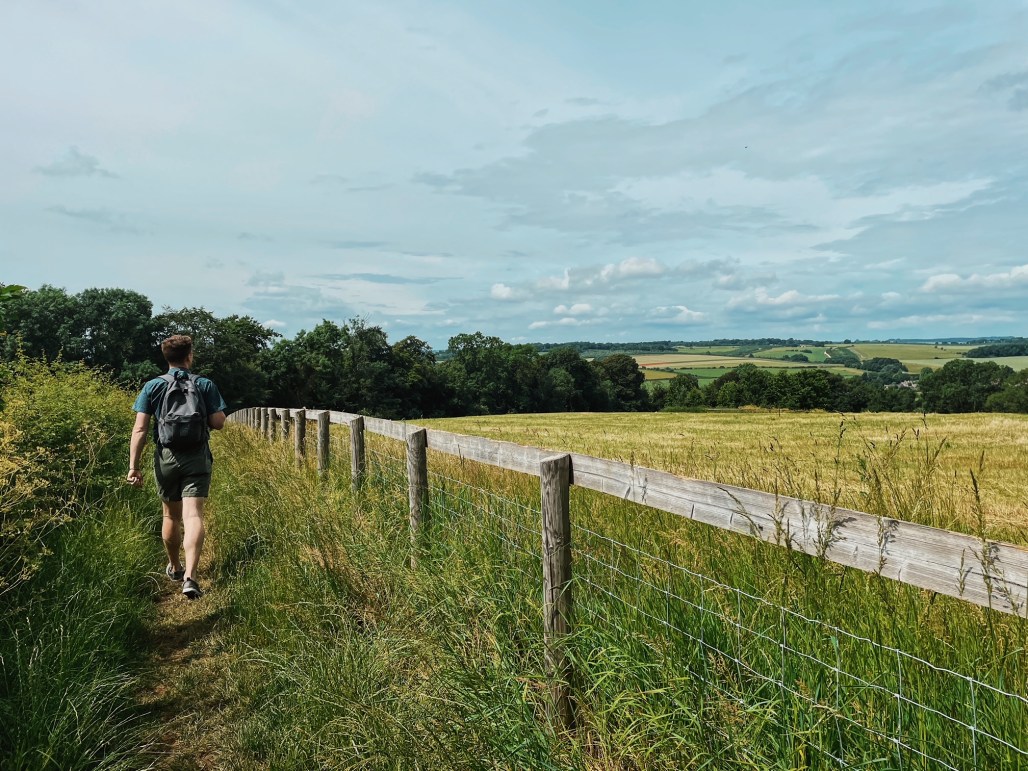
Soon after, we finally saw a sign for the Gloucestershire Way public footpath and happily began trekking across a pastoral field. Before I continue, let me just say that I absolutely, completely, enthusiastically adore England’s public footpath system. As someone who loves walking and hiking, especially when it is relaxed, quiet, and picturesque, I have a deep appreciation for this English cultural practice that has stood the test of time and continues to be defended today when private landowners want the footpaths closed off.
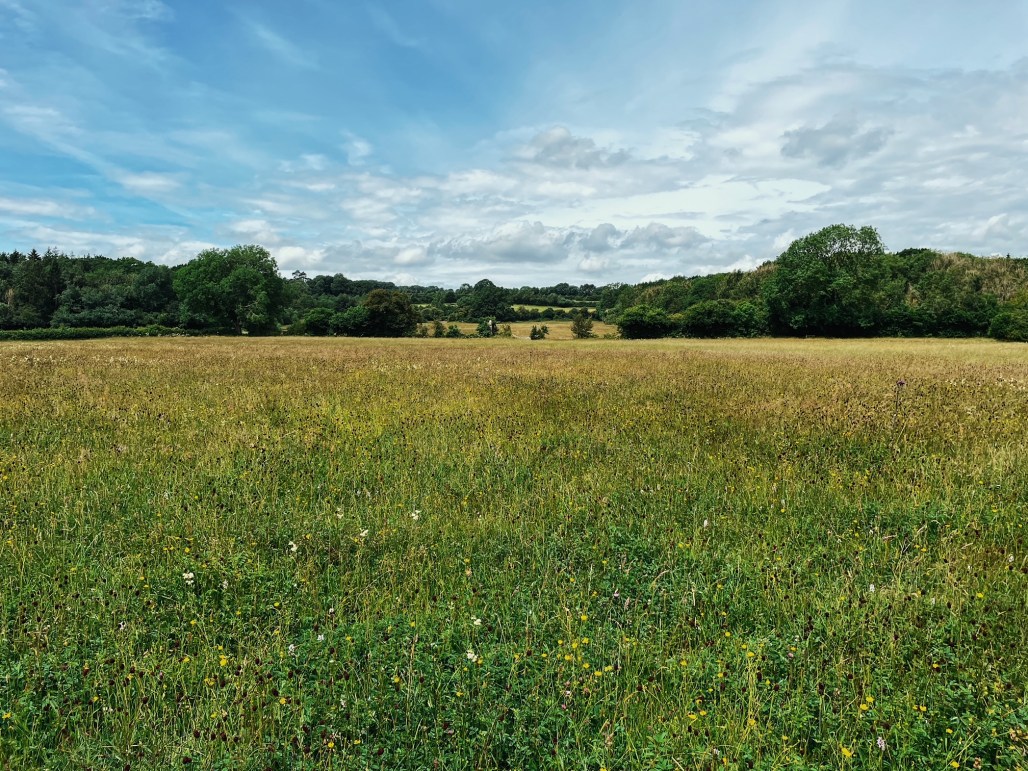
Anyway, now that I’ve waxed poetic about public footpaths, I’ll continue. The first leg of our hike took us across those quintessential rolling fields (aka wolds), through woodlands, and down into valleys. I gasped the first time we reached a hilltop with miles-long views over the wolds, their countless hedges, and their limestone cottages & barns. We didn’t pass many other folks, but when we did, they always greeted us like they too were having the time of their freakin’ lives along that footpath.
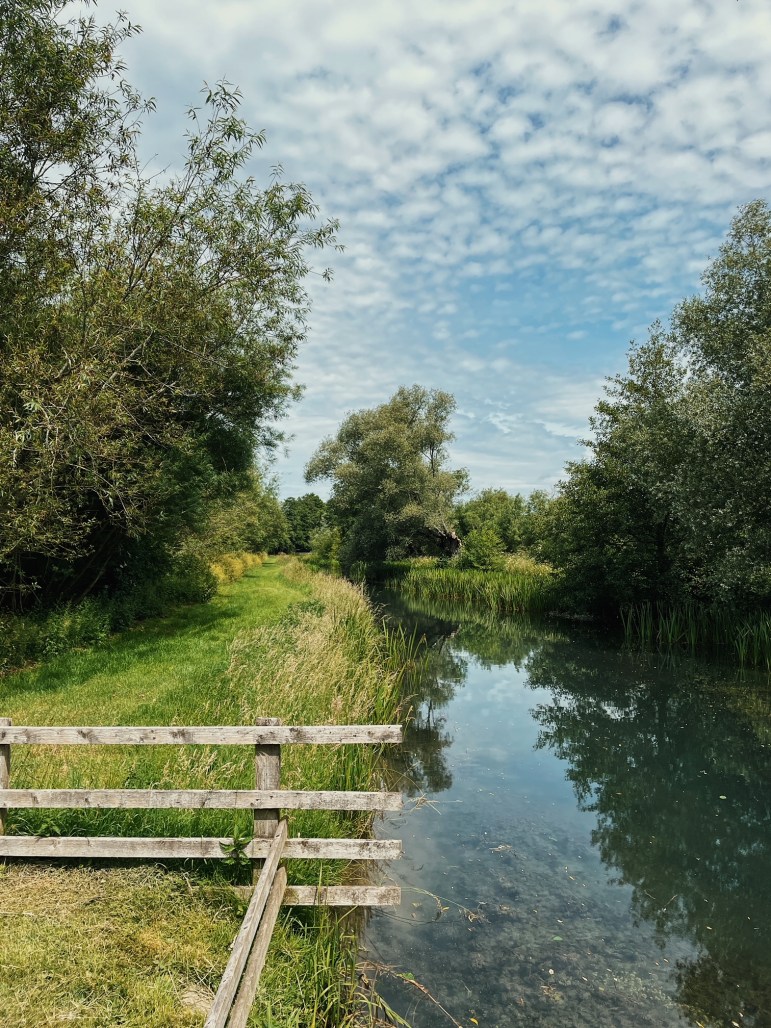
At one point, we happened upon a large estate, complete with hillside manor house and equestrian farm. It was a tad astounding how many times we would end up stumbling upon behemoth old manor houses during our hikes. After taking a moment to say a chipper hello to some of the horses, we continued along our way, dodging piles of manure and crossing the small River Dikler.
The weather was truly gorgeous and only in the low 70s (which was considered a heat wave at the time), but the uninhibited sun was causing us to sweat a bit. When a life-giving breeze danced along the field we were crossing, I held my arms out and threw my head back, trying to catch as much of it as I could. Of course, this was the moment I noticed someone walking toward us from the other side of the field. The gentleman, obviously a local, stopped to greet us, even saying, “We love Americans!” He chatted with us for a bit, letting us know that the next field was full of milking cows and to not be afraid of them. Thinking the Cotswolds must see a lot of folks who haven’t been around cows, we assured him we grew up around them and actually quite like them. This news seemed to please him, him replying, “That’s fantastic!” Calling an unreciprocated hello to the milking cows and tutting at the fact that fellow hikers were not always closing gates behind them, we soon began to see the village of Lower Slaughter, our first stop.
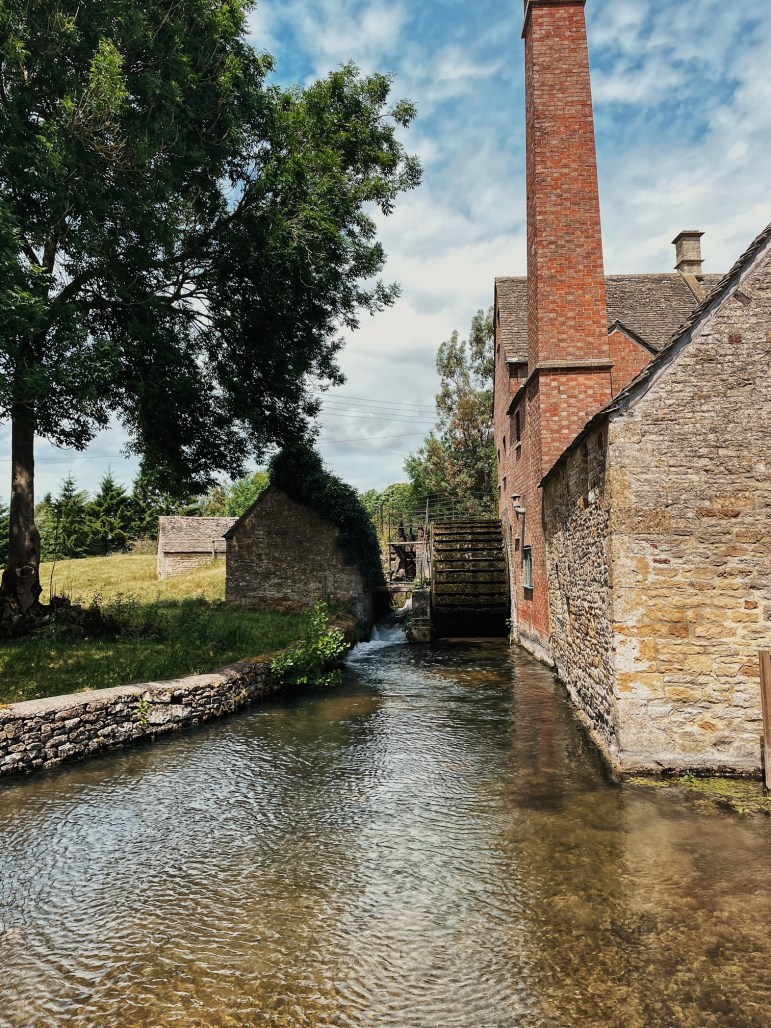
Our first view of Lower Slaughter was actually of its cricket pitch as the footpath led us by it, but we were soon in the midst of the idyllic limestone village, passing a stunning centuries-old church and skirting the amazingly shallow River Eye. When I say it is a tiny village, I truly mean tiny. Only a handful of other folks were walking around and some beautiful horses—part of an equestrian tourist ride—were rehydrating in the river. The river, only a few inches deep and pebble-bottomed, meanders between the stone houses and helps turn a wheel that is part of an old mill, now ran as a museum. We had considered popping into the museum, but it didn’t appear to be open, so we looked around at some of the houses, noticing a few with “No Photos” signs.
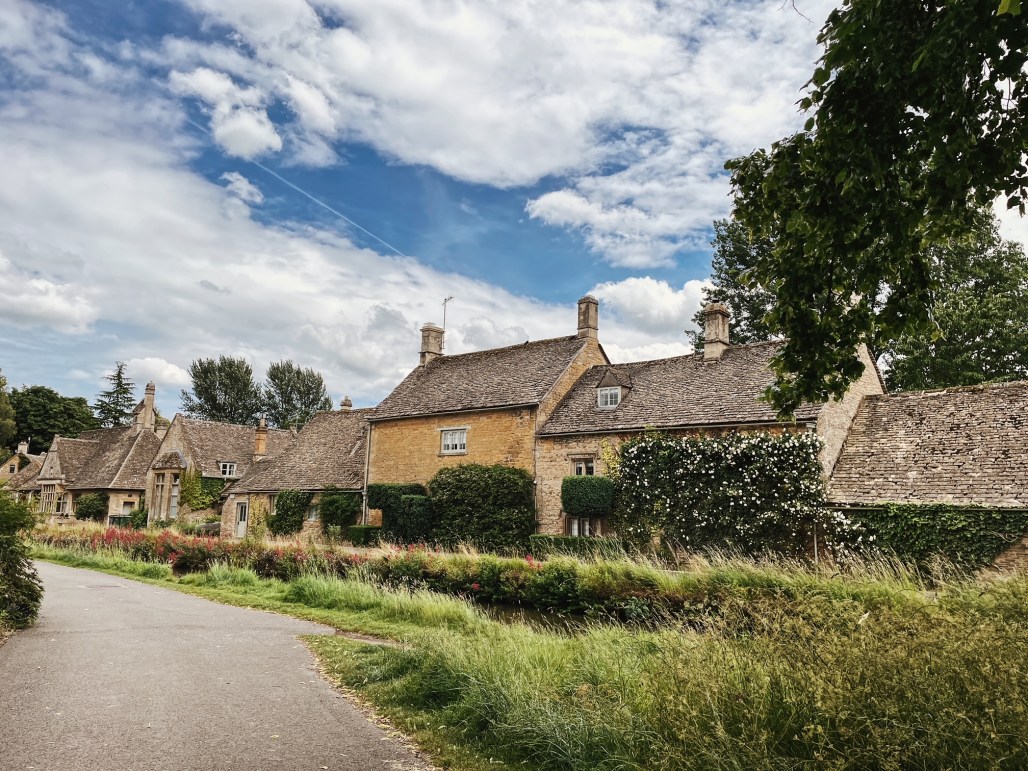
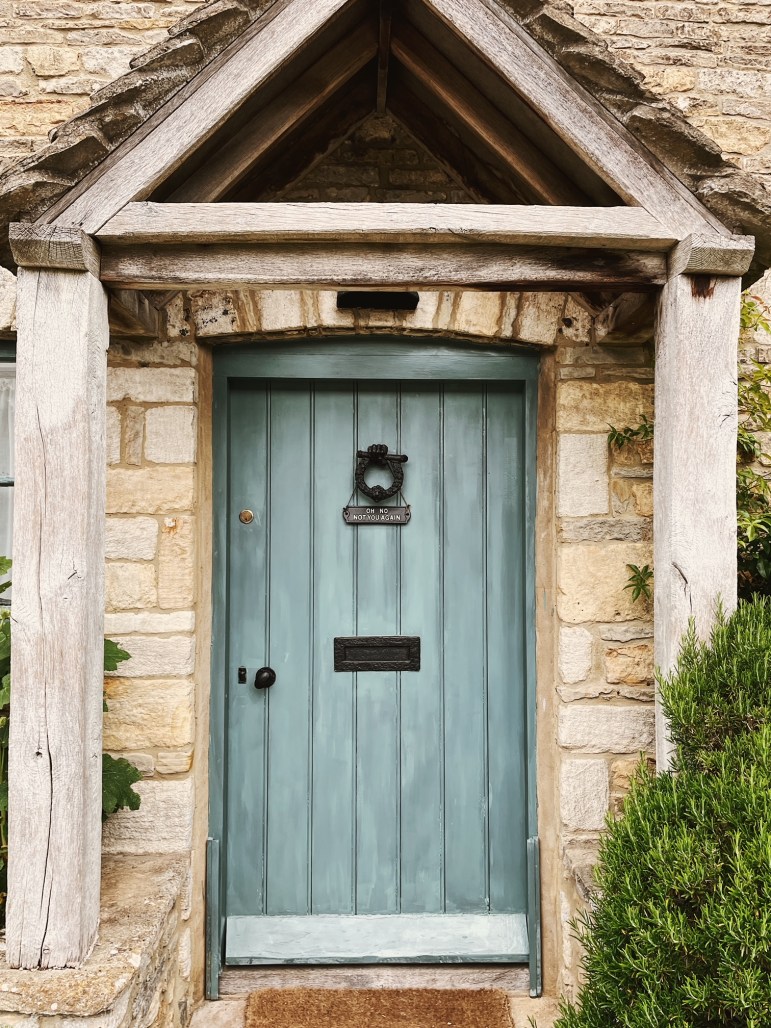
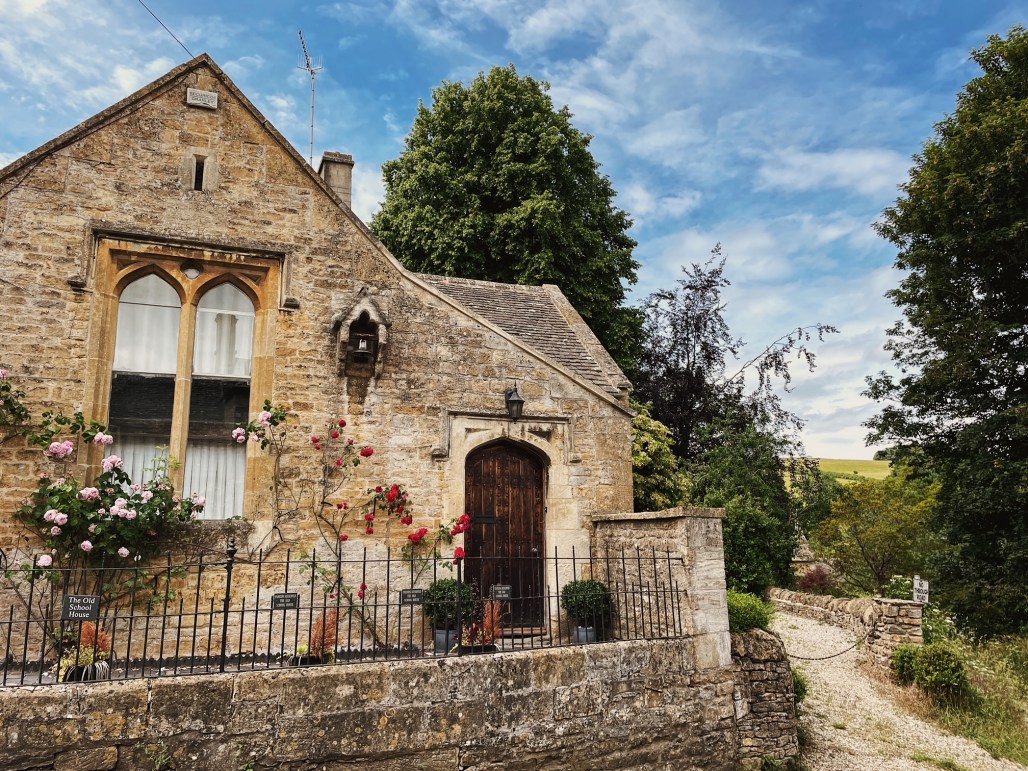
Though it wasn’t on our way to our primary stop for the day, we wanted to see the equally tiny village of Upper Slaughter, so we treaded another mile-or-so west through more meadow, woodlands, and even along an ancient, moss-covered stone wall that towered over me. Just as sleepy and just as beautiful, Upper Slaughter greeted us serenely. The 12th century church of St. Peter’s rests quietly atop a small hill and it beckoned us toward it. In front of the church sits an old stone schoolhouse (where there is literally a sign that says, “The Old School House”) that I absolutely fell in love with, deeming it my new dream house. I wasn’t the only one who had fallen in love with it, as we saw a few others taking photos of it as well.
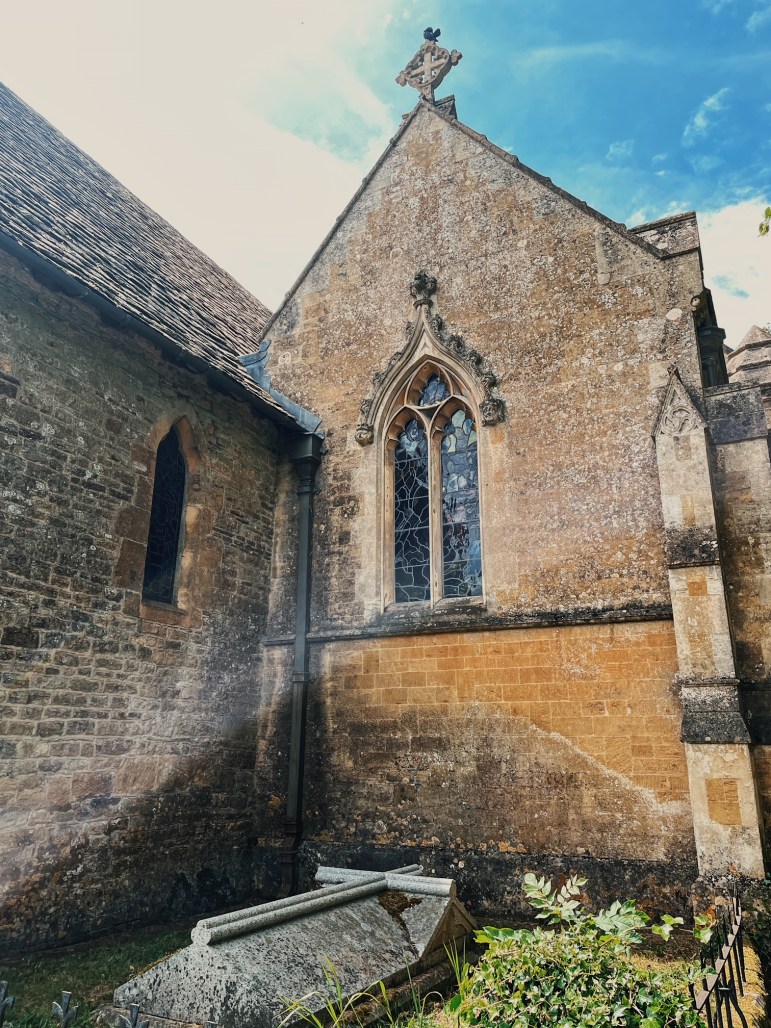
We walked the exterior of St. Peter’s first, taking in its tower, old gravestones, and stained glass. As we were nearing the entrance, a woman popped out and told us to feel free to go in and have a look around. The bottles of water for sale on a table inside told us that the church likely has lots of tourists coming in to have a look around. We read about the church’s Norman period beginnings and gawked up at its high timber-framed ceilings. Headstones of passed parishioners make up much of the floor, which is a common practice, but I always feel strange about stepping on them nonetheless.
Satisfied with our look around, we retraced our hike back to Lower Slaughter in order to carry on to our third and final destination of Bourton-on-the-Water. From Lower Slaughter, we followed the River Eye much of the way, passing the equestrian center responsible for the tourist rides we saw earlier in the day. We would later attempt to schedule one of these tours, but to no avail. Almost to the center of Bourton-on-the-Water, we passed a school, evidently having a recess period, and heard a kid yell, “I’m using white magic!” That kid probably would have been my best friend in school, but I digress.
Shortly after, we found ourselves at another impressive old church, St. Lawrence’s, and noticed that its churchyard was quite wild-looking with tall foliage hugging the headstones. A sign explained that the churchyard goes unmown in the summer in order to help pollinators—an endeavor I quite appreciate.
When we had seen our AirBnb hosts earlier in the morning, one had mentioned the crowds of tourists making Bourton basically unenjoyable. We were, indeed, met with hoards of fellow tourists upon stepping onto High Street, but it didn’t dampen it for us. Actually, like the folks we passed along the public footpaths, everyone seemed to be having a jolly old time. I’m used to seeing a lot of tourists looking exhausted and/or stressed out, but these folks just weren’t. They were happily popping into and out of shops, sitting on patios sipping from a cup or mug, or resting by the River Windrush, which—like the River Eye—meandered through the center of this village as well.
The most tired-looking people were probably Andrew and I, after our eight miles, because we were gasping for some caffeine. After crossing one of the several bridges that span the width of the small river, I spotted Bakery on the Water, remembering its façade from several Instagram posts. “Why not?” I thought, and led us inside. I must say, that lovely café deserves any attention it gets on social media as beyond its cute façade lie delicious food and a stunning back patio that abuts the river. We truly lucked out with a table right beside the river, where we could watch and listen to the water rush over stones before mellowing out further down. The idea of teatime appealed to us again and we essentially repeated our order from the day before, me getting a scone with jam and a flat white, and Andrew enjoying a scone with cream and a pot of tea. I had ordered for us while Andrew watched over our treasure-of-a-table and saw a cheese and onion Cornish pasty I thought he would like, so I added it to the bill. He did, indeed, really, really, like it. We lingered for a while after finishing our food, relishing our caffeine and the view. Smart birds occasionally scampered across our feet under the table, looking for scone crumbs.
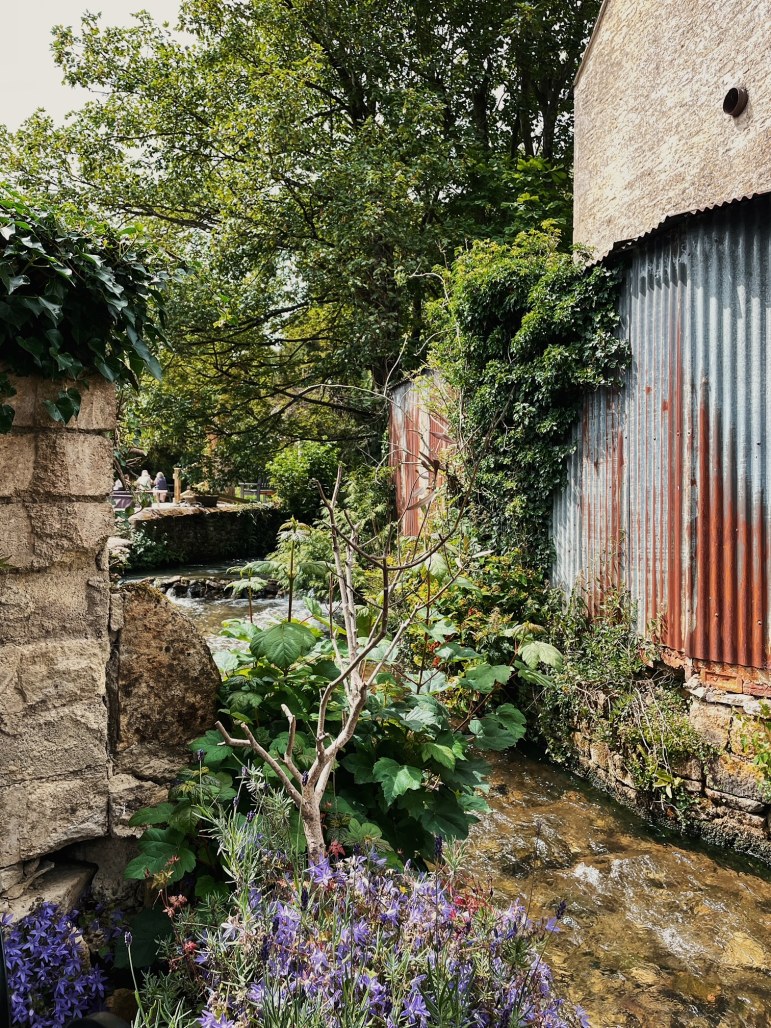
We spent the next couple of hours stepping into some of the numerous shops (goodness knows we can’t walk past a charity shop or antiques shop without walking in) and bookmarking appealing pubs for later. This was another quintessential limestone village. With the River Windrush settled between two busy streets and obviously playing a large part in experiencing the town, Bourton-on-the-Water is often called The Venice of the Cotswolds.
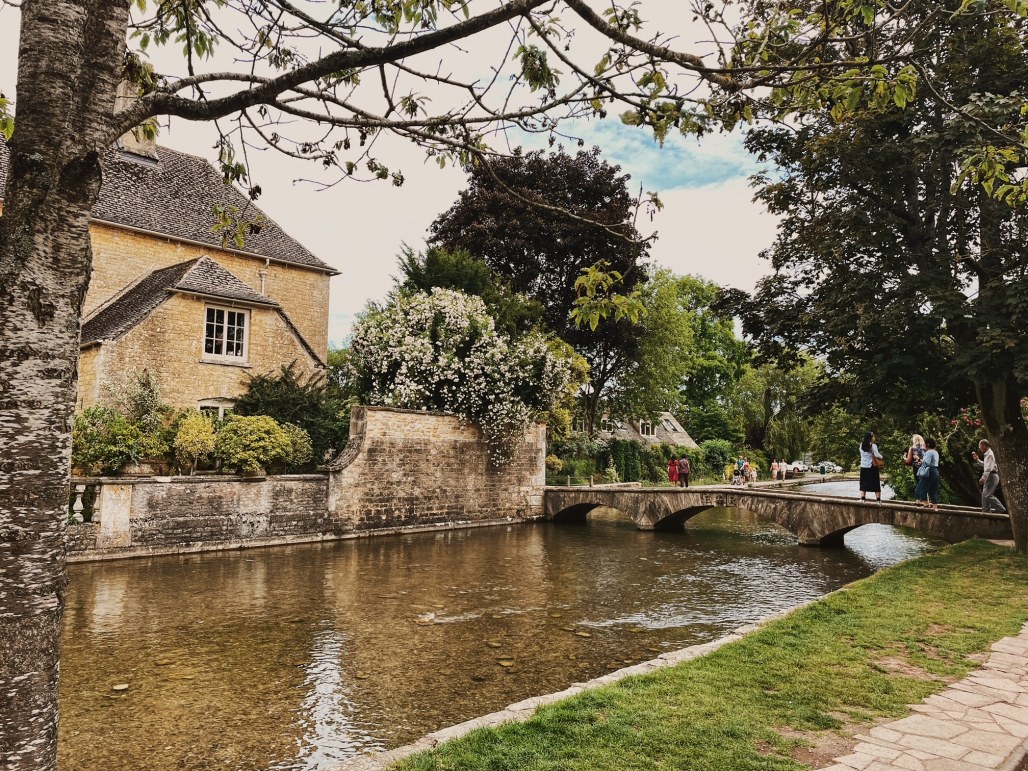
Once we’d completed our circuit, we circled back to the Kingsbridge Inn’s pub with its large, riverside, outdoor patio. Andrew took the opportunity to sample a couple more local beers while I ordered my usual G&T. Instead of sitting at a table, we grabbed a couple of chairs and turned them to face the river, as well as the two streets straddling it. We people-watched, admiring stylish clothing and wanting to pet every dog that passed. Kids and dogs alike played in the shallow, lazy river and people picnicked on the grass. A restaurant across the street, The Chip Shed, looked more like it should be called The Fancy Chip Boutique, since it sat within a beautiful Georgian building. It felt as if we saw hundreds of people walk out of the front door with those white paper bags, and we were jealous of every single one of them. We were sincerely wishing we were hungry.
We had (probably foolishly) considered hiking back to Stow, but since it was around 5:30 pm when we finished our drinks, we decided to do another short walk of the town and catch the bus instead. Once back in Stow, we began to get hungry (why couldn’t we have been hungry when we were by The Chip Shed?), so we went back to The Bell for dinner. We were fortunate to find a table, as it was a Friday night, so we thanked our lucky stars and took in more of the beautiful pub. After a hearty meal, we evidently hadn’t had enough walking for the day and went for a post-dinner stroll around town, talking about how we wished it were something that were easier to make a habit of in our everyday life. One day, we will take nightly post-dinner walks around whatever beautiful town we live in.
Back in our cottage, Genghis undoubtedly getting into mischief somewhere nearby, we laid in our bed with the French doors open and talked again of our love of public footpaths and how we were looking forward to further exploration of Stow the following day. We still had more coffee shops and pubs to test and they certainly weren’t going to test themselves.
Until Part IV,
Lara


 awefaring
Leave a reply to johnwreford Cancel reply